Sunday, October 7, 2012

SEOS Project: Box Construction Day 2

I started off the day by making a new, slightly smaller router base since the waveguide cutouts I was getting from my template were too small. Once that was fixed, I made a jig to align the front baffles underneath the template. Since the template is much larger than the baffle, I needed something to hold it up as I traced it, and also a way to make sure it was properly aligned on the baffle. To do this I took some scrap MDF and made a slot that I could slide the baffle into under the template. This made sure the template was aligned consistently for every cut and that the baffle didn't move. I simply clamped down the open end, and the baffle stayed put as I went to work with the router.


Below is what the baffle looked like after the first pass with the router. I made the recess about 5/16" deep and made sure to do the outline first. Then I went back in and chipped away around the edges until there was enough left over to seat the waveguide.


Next I used a jigsaw to make the rough cutout for the waveguide. It doesn't have to look pretty since the waveguide will cover it, so I made quick, rough cuts.


Once the waveguide holes were made, I got started on making the woofer cutouts. Comparatively these were extremely easy. Since I was using a 1/4" router bit, I had to make three separate passes, each one just smaller than the other to get down to the size where I would make the cutout.

First pass

Third pass

Final cutout
After all the cutouts were made, I went ahead and cut some more rings for the inside of the baffle. Since I cut about 1/3" for the recess I wanted to make sure there was plenty of stuff for the blind nuts to bite into on the backside. I did the same for the waveguide, but just cut some triangles for the corner. I originally meant for there to be a two layer baffle of 1/2" and 3/4" MDF, and had cut out the 1/2" pieces, until I realized that my flush-trim router bit only has a 1" cutting surface. A bit of an oversight, but I think this solution works perfectly well, and keeps the weight down a little.


Next up, I cut out some spare Baltic Birch to make some braces. These are 3/4" x 1 1/2", and are enough for all three cabinets. There will be two side to side braces, two front to back, and one top to bottom for each cabinet. After the boxes are complete I'll use a chopsaw to cut them to length and glue them in.


For the rings, I applied some glue, and rather than waste clamping time, I just shot it through with a few screws to hold it down while the glue dried. The glue is more than enough to hold it, but I'll leave the screws in.


I used a drill press to drill the holes for the mounting screws since I don't trust myself to drill the holes straight with a handrill and there isn't much space to work with.


Once the holes were drilled, I tapped in the hurricane nuts with a mallet after applying some Gorilla Glue to them. The nuts are supposed to hold themselves in, but I've spun my fair share of them, and it's no fun trying to fix it, so the expanding Gorilla Glue should do the trick. I'll also make sure to chase each one with a tap before trying to mount the drivers.


A row of finished baffles! The front baffle always takes up about 90% of the build time. The waveguide cutouts have 8/32 hurricane nuts, and the woofers have 10/32 nuts.


A quick test fit of the driver and waveguide in the front baffle. Looking good so far!


Clamping up the front and back. It's always a pain to get things aligned correctly, so I made them slightly larger than needed, so I can just trim them up with the flush trim bit and be done with it.


Friday, October 5, 2012

SEOS Project: Box Construction Day 1

I woke up this morning to get started cutting some wood for the speakers, and found a great surprise. My parents are celebrating my birthday early since I won't be home on the actual day, and when I walked into the garage I was greeted with this:


I haven't had a chance to use the orbital sander just yet, but table saw has already proven to be worth its weight in gold. When it come to making repeatable cuts, nothing beats a table saw, and this made short work of the cuts that I had to do. Thankfully when I went to Home Depot, a helpful employee cut a couple 15" panels out of the full 4'x8' piece on the panel saw, which also significantly cut down on my work.


Before making any cuts I did a few checks to make sure the saw was properly aligned. I measured from one of the teeth on the blade to the fence, then rotated the blade until the tooth was at the back of the blade and measured again.

Since the measurement was the same, the blade was well aligned with the fence, and I got started on making the cuts.


There was a small setback, since I found that I had misjudged the sizes of my material, and I'm currently short one 19 1/2" x 14 1/2" side pieces. I'll get some more MDF when I get the chance, and cut that last piece.

Once everything was cut out I clamped up the sides and the top and bottom for one cabinet, leaving a bit to hang over on the top and bottom so they could be trimmed flush with a router later.


While the glue was setting up, I got started making the template for cutting out the recess for the waveguide. I followed the instructions in this post on flush mounting irregularly shaped drivers and started by making the larger router base. In the picture below is the circle jig I made for my router, including the incorrectly measured hole for the cutout.


Without thinking, I measured to the far end of the bit, which resulted in an exactly 6 1/4" diameter hole, and a 1/2" smaller cutout, so I remeasured and finally cut out the 6 1/4" disk I would go on to use as the larger router base.


Once the larger router base was cut, I put the original base back on. Next I screwed the waveguide into the MDF (this time 1/4" thick) and traced around it with the router to make the template.


With the angle on the edge of the waveguide, the router base ended up tracing a little too close and made the template slightly too small, so I'm going to cut out a slightly smaller custom router base which will make the final cutout larger. Tomorrow I should be able to finish up the front baffle and hopefully close up one of the boxes.

Thursday, October 4, 2012

SEOS Project: Preparing to make sawdust

With both drivers in hand, I got started taking some measurements needed to being work on the enclosure and the crossover. First I measured the impedance curve for the Eminence Deltalite-II 2512 in open air and on a 1 cubic foot box. The equipment in the lab output a text file with the impedance data that I imported into REW to produce these graphs:

Off Box

On 1 ft^3 Box

REW also has a handy tool that will derive the driver parameters from the impedance graphs, so using that I got the following parameters:

TS Parameters file
Room EQ V5.01
Dated: Oct 3, 2012 8:29:47 PM
From measurement Eminence 2512 off box.
Zmin 5.41 ohm
fmin 213 Hz
f3 1036 Hz
Le(f3) 0.508 mH
Motional impedance parameters
RES 137.61 ohm
LCES 35.003 mH
CMES 373.5 uF
RAMS 137608.424 mohm
Blocked impedance parameters
RDC 4.50 ohm
dR 0.26 ohm
Re 4.76 ohm
Leb 131.0 uH
Le 2.001 mH
Rss 1503.6 ohm
Ke 0.0619 S-H
Thiele-Small parameters
fs 43.5 Hz
Qms 4.355
Qes 0.485
Qts 0.437
Fts 99.6
Mms 61.15 g
Cms 0.219 mm/N
Rms 3.836 kg/s
Vas 83.90 litres
Bl 12.796 Tm
Eta 1.39 %
Lp (1W/1m) 93.58 dB
Dd 25.72 cm
Sd 519.5 cm^2
Vb 28.317 litres
Secondary measurement: Eminence 2512 on box 1
Air temperature 20.0 C
Air pressure 1013.25 mB
Air density 1.2041 kg/m^3
Speed of sound 343.2 m/s

The data seemed quite different from the published specs (2512 Specs), but when I modeled it in WinISD, there actually wasn't a huge difference.

Below are the modeled system responses for both the published specs, and the measured parameters with a single driver in a 2 cubic foot box. I opted to go for a sealed box for several reasons: I'd like to keep the size manageable, going sealed simplifies the box construction, and finally since I plan to cross these over with subwoofers, I get plenty of extension (70ish Hz) for that purpose.

Going ported would allow a flat response down to around 40 Hz, which still wouldn't be full range, so subwoofers would be needed, and the crossover would be around 80 Hz anyway, essentially wasting the low frequency extension gained with the ported design.


Yellow: Given  Blue: Measured

Once the size of the box was chosen I went ahead and played around with the Enclosure Volume Calculator to arrive at the final dimensions. The only starting dimension was 15" wide for the front baffle to fit the SEOS waveguide with a little room to spare. I could have made it much taller and less deep, but it still wouldn't be tall enough to be floorstanding, and I'd rather just make stands for them later anyway. The .2 cubic feet entered for the driver volume is a rough estimate of the woofer, waveguide, and bracing. The final volume will not be exactly 2 cubic feet, but I tried to err on the larger side, since a slightly larger box will give a little more extension.


Finally, with the dimensions in hand I made up a cut list using a free program aptly named Cut List. It will try to find the most material efficient layout of panels, which can be nice, but in this case I just entered the panels and manually arranged them (which can be done just as easily with a sheet of paper and a pencil). I laid out the panels so that I could rip down the material and make sure that all of the panels had the same width (especially the 14 1/2" pieces since they must be identical). The 15" pieces aren't as critical since they'll be going on the front and back and I can just trim them with a flush-cut router bit.


Finally, I had to decide on what type of material to use. I'm very fond of the Baltic Birch plywood I used for my subwoofer project, since it's extremely strong, void-free, and fairly lightweight. It also has some decent looking grain, so with a little finishing work it provides a handsome natural wood finish. However, since these speakers will eventually go in a home theater (hopefully with a projector) they're going to get a more functional-- and less flashy-- matte black paintjob to reduce light reflections. And there isn't much that takes paint better than MDF, so that's the material I'll be going with. I'm not a fan of the ridiculous dust from the stuff, though, so I'll probably be picking up a respirator or at least a heavy duty dust mask when I go to the hardware store.

Thursday, September 20, 2012

SEOS Project: Waveguides are here!


Since the last post I've been waiting for the compression drivers and waveguides to arrive so that I can get started measuring and modeling the speakers, but to pass the time I've been doing some research about constant directivity loudspeakers, and the kinds of tools I'll be using to help me design them.

The Pi Speakers Whitepaper was the first source I looked at to get a sense of what's going on in a constant directivity system. It starts off with some background on horns and waveguides, and what kind of advancements led them to their current form, then it gets into how to integrate them into a two-way loudspeaker system. There is actually a lot more to consider when designing the crossover for a constant directivity system than just passing the correct frequencies to each driver. Since the goal is, of course, constant directivity, that means matching the directivity of the woofer to that of the tweeter at the crossover frequency, which adds a considerable amount of complexity.

Thankfully there are lots of resources available when it comes to crossover design. Next up on my reading list is also from Pi Speakers, and it's referred to as the Crossover Document. At over 70 pages, it's a hefty read, but I'm hoping it will expand upon what I've already picked up from Leach's Introduction to Electroacoustics and Audio Amplifier Design.

In addition to reading up on theory, I've been scouting out some programs to help me measure the drivers, design the crossover, and model the final system before spending any money on crossover components. Here's what I've found so far:

Room EQ Wizard (REW): I've used this in the past for measuring the in-room frequency response of my subwoofers, but it also has the option to measure driver impedance and spit out parameters for use in modeling software.

WinISD: Using the driver parameters, this program models the transfer function of the driver in different enclosures.

Passive Crossover Designer 7 (PCD): This program takes in raw impedance and frequency response data from each driver, and allows you to design and model a crossover while providing graphs for frequency response (at any position in relation to the system) and directivity. This program will also model different enclosures and can use that data for the crossover design.


Finally, last but not least, my compression drivers and waveguides just arrived today. The waveguides are made out of extremely thick and heavy plastic, and feel incredibly solid, although next to the compression drivers, they're lightweights. The DNA-360 is a monster! These things are much larger and heavier than I expected, and I wouldn't be surprised if the CD/waveguide combo weighed more than the woofers do. For some size reference, here's a picture of me holding one of them.


Tuesday, September 11, 2012

SEOS Project: Getting Started


I actually started the research on this project a while ago, so for this post I'll be playing a little bit of catch up and getting everyone up to speed on the progress I've made so far.

Originally in my search for another speaker project to work on I came across this thread about "Econowave" speakers. The idea behind them is to use a compression driver with a waveguide paired with a large woofer, resulting in high sensitivity that allows playback at reference levels with low power requirements. Additionally, the waveguide controls the directivity of the tweeter, narrowing it to reduce unwanted reflections, especially in the vertical plane.

Another resource I found as I was looking at these kind of speakers was the Pi Speakers website which uses the same idea although arguably in a more polished form.

Once I had decided that the constant directivity (CD) speaker was the way to go, the next step was to start figuring out what I wanted out of them, and from there which components to use.

Really my only requirement is that the speakers play low enough to crossover to a sub at 80Hz, which even with a sealed design should be doable. Since I don't plan to listen at reference levels (peaks up to 105dB from the main speakers and 115dB from subwoofers), that is a secondary concern, but with the high sensitivity of constant directivity speakers, it's a very achievable goal. Finally, since my goal is to never have to replace these, I set the budget to around $300 per speaker for electronics.

With that said, here are some of the options I considered when choosing components for this project:

Waveguides
QSC PL-000446GP Replacement Waveguide Horn for HPR152i ($35)
SEOS ($30) (http://www.diysoundgroup.com/waveguides/seos/plastic-seos-matte.html)
Dayton H6512 ($7)


Compression Drivers
B&C DE250 ($130) (http://www.parts-express.com/pdf/294-605.pdf)
Denovo DNA 360 ($75) (http://www.diysoundgroup.com/drivers/tweeters/dna-360.html)
Denovo DNA 350 ($57) (http://www.diysoundgroup.com/drivers/tweeters/dna-350.html)
Selenium D220Ti ($50) (http://www.parts-express.com/pdf/264-270s.pdf)


Woofer
Eminence Deltalite-II 2512 ($150) (http://www.eminence.com/pdf/DeltaliteII_2512.pdf)
Eminence Delta Pro 12A ($135) (http://www.eminence.com/pdf/Delta_Pro_12A.pdf)
Eminence Delta 12LFA ($100) (http://www.eminence.com/pdf/Delta_12LFA.pdf)
Dayton Audio PA310-8 ($65) (http://www.parts-express.com/pdf/295-032s.pdf)

The Dayton woofer and Selenium compression driver were used in quite a few of the Econowave designs, which is why they show up here along with the QSC horn. That pairing would have been my initial choice based on their price and the success people have had with them in the past, but after looking around some more I came across the SEOS project. The waveguide measured very well, and the DNA compression drivers offered alongside them are very comparable to the much more expensive B&C DE250.

With the SEOS and the DNA-360/350 looking like the best option for the high end, I wanted to find a woofer that could keep up, so I finally settled on the Eminence 2512 which offers better sensitivity, power handling, and extension than the Dayton (or some of the other Eminence offerings).

As of right now I've ordered the SEOS and DNA-360 as well as the 2512s (which just came in), and I'll be starting measurements and modeling the speakers so I can begin designing the crossover.


That was a pretty dense post, since I had to cover a lot of progress all at once, but it'll be a little more broken up in the future (and there will be more pictures once I get my camera from home).

Wednesday, April 4, 2012

Subwoofer Feet


Well, it's been a while since the last update, but it's finally here! I just got in a set of feet to finish off my subwoofers (for now). I was eyeing some nice satin nickel spikes, but instead opted for some much less expensive rubber feet since I was fairly certain the spikes would have absolutely no affect on the performance of the speakers. Below are the feet in their packaging.


To install the feet, I first marked the bottom of the cabinets. Instead of measuring every corner, I marked on a scrap of paper (making sure to denote the corner) as a template, and just used a screwdriver to make a divot in the cabinet after aligning the paper.


Next I drilled some pilot holes, and moved up to the full sized bit for the threaded inserts. Then I put a dab of glue on the insert and screwed them in. Finally I screwed in the feet, and I was done. I was surprised at what a difference it made in appearance. The floating look makes them look much more professional than before, and I'm very pleased.


Since I was curious to see if the feet made any difference in the frequency response of the speakers I went ahead and measured before and after. As expected, there was almost no difference in terms of the performance. However, lifting the bottom of the cabinet off the ground did help prevent some of the vibrations from carrying through into the room, which I consider an improvement.


Wednesday, December 7, 2011

New Finish on Overnight Sensations


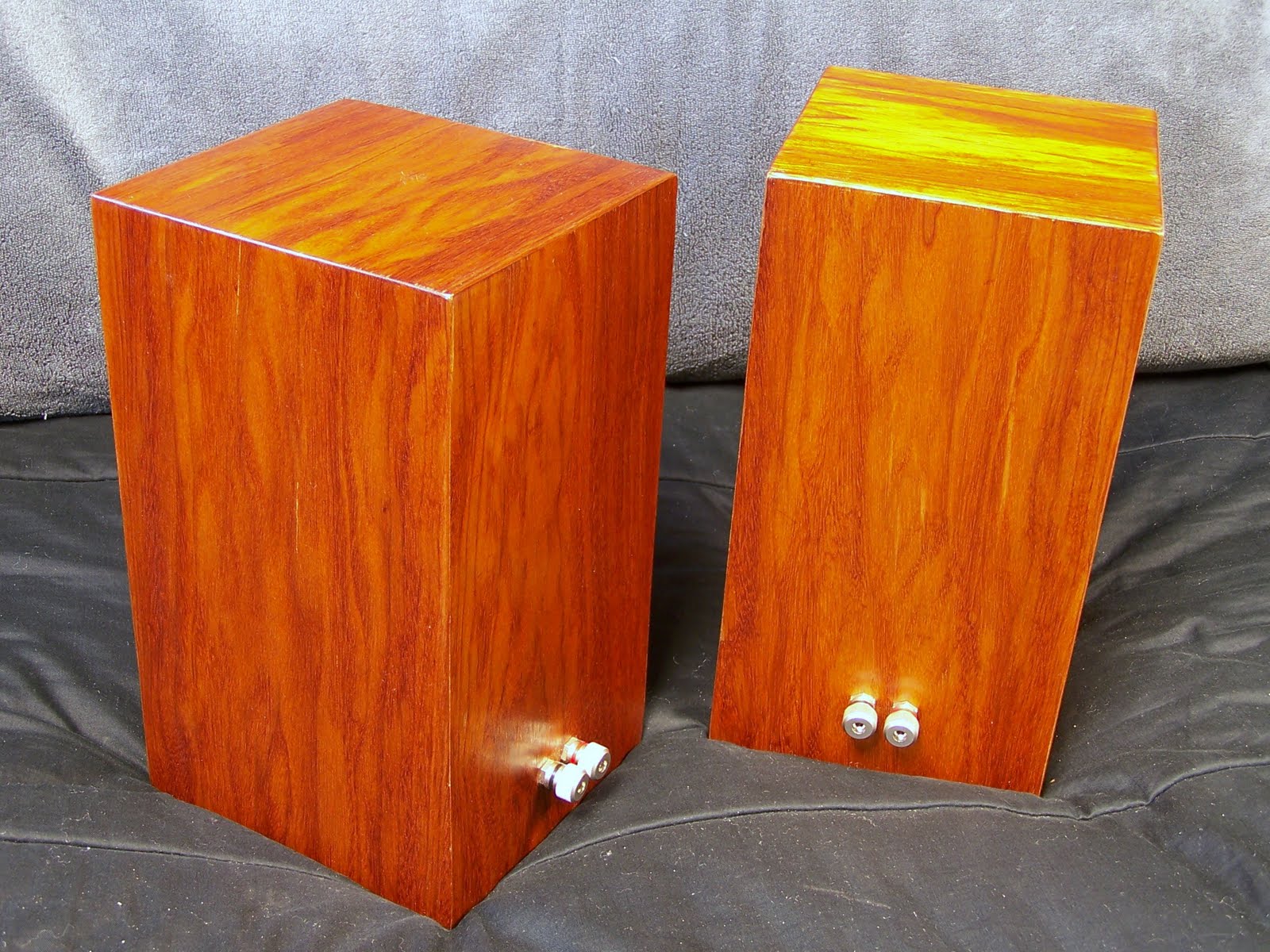
It's been a while since I last posted, but here's a small update on my Overnight Sensations project. After a while of looking at these guys sitting on my desk, I decided that the finish was beginning to look pretty flat, and once the Danish oil had completely cured, the wood ended up with an almost sickly dry look to it. I had great success with the Wipe-on-Poly I used with my MFW-15 subs, so I got some more to bring some new life to my bookshelf speakers. I opted for the satin finish since I didn't want the speakers to jump out too much, and it ended up being the right way to go. There's just enough sheen to add depth and give the wood that "wet" look, but without blinding you. I'm very happy with the result.

You can see some of the original finish in my build log here: Overnight Sensations Build Log.