Monday, August 22, 2011

Pioneer VSX 1020-K


I finally took the plunge and got myself a new receiver to take advantage of the HD audio formats on Bluray. After weeks of agonizing over which receiver to get, I finally landed on the Pioneer VSX-1020-K mostly based on price. Being last year's model, it was a steal, and still had all the features I wanted (and then some).

My main requirement was just that the receiver had HDMI connectivity, since I wanted to see what I was missing with the lossless audio tracks on Bluray. Since almost every receiver made recently has HDMI connectivity, that did little to narrow down the field. After HDMI, I wanted two zone support so I could power my desktop speakers from the same receiver, and finally I wanted a receiver with some room correction software to play around with. After lots of comparisons, I ended up with the 1020-K since it was the least expensive of the models I was contemplating.

Aside from the features I was looking for, this receiver includes networking functions and internet radio which I'm looking forward to messing around with in the future. For now, what's been taking up much of my time is fiddling with the Advanced MCACC room correction software that comes installed on the 1020-K. The receiver comes packaged with a small calibration microphone that it uses to adjust channel levels, time delay, equalization, and standing wave compensation.

My first impressions of the settings made by MCACC are favorable. It set all the channel levels and distances spot on. The EQ is a more subtle effect-- nothing like the night and day differences I read about everywhere, but I think it improved the clarity of the sound, and overall I'm very pleased. Now I just need to figure out how to interpret the reverberation graphs it generates so I can properly set the time capture, and hopefully improve the room correction.

Overall my experience with the Pioneer VSX 1020-K has been very good, aside from some shipping shenanigans (not a fault of the receiver itself).

Thursday, July 28, 2011

Sub Project: Lookin' Good

At last! Here they are in all their glory. They turned out much better than I could have hoped, and I just can't stop looking at them. I'll shut up now so you can enjoy the speaker porn.


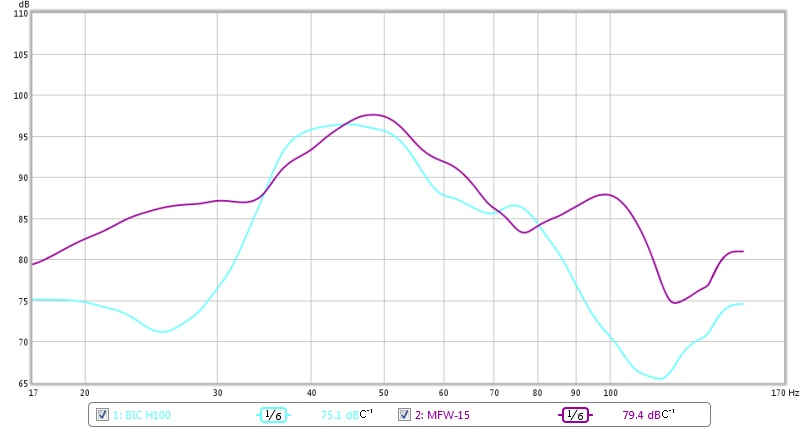
I did take some quick measurements comparing these with my old subwoofer. I'm beginning to think there's some pretty heavy room interaction causing that peak at 50 Hz since it affected both setups (one of the MFW-15's is in the same position as the H100 was). I didn't add any offset to these measurements, and I tried to match the levels as closely as possible, so you can see that I don't lose any output at all from the switch to sealed from ported (not too surprising since I added a second sub). I did gain a lot of extension, though, which is what I was after.

I hope everyone enjoyed watching this process as much as I enjoyed carrying it out. I'll keep you up to date on any new projects I come up with, but for now I'm taking a break.

Tuesday, July 26, 2011

Sub Project: Almost There...

I finally managed to get through the finishing process. I know I had originally planned to put about 8-9 layers of topcoat on these, but it turns out they look pretty good after just three (and a fourth light one on the top and front). While I had them disassembled for finishing, I did a couple other things that I neglected to do the first time around.

The first of which was just because I had planned to open them up again, and that was adding bracing from the top to the bottom. I don't think it was an issue when I had them hooked up earlier, but I had the wood, and there was no reason not to. These things were solid as a rock before, and now they're even more so.

Next was something that I decided not to do at first, but ended up wishing I had done, and that was soldering the internal wires to the connector. The crimp on terminals I used didn't fit very well, and I was afraid they would come loose eventually. Now I don't have to worry about that.

I'll put up some beauty shots when they're fully assembled, and then do some more measuring when they're back in the system. I'm going to take the opportunity to compare these to my BIC Acoustech H100 (a ported 12" woofer). I'll do the normal frequency response, and try to work through some THD measurements.

Monday, July 18, 2011

Sub Project: Stain Sneak Peek

Here's a crummy photo of the freshly stained subs. They look a little dull right now, but the color is right, and it'll really pop once it gets that "wet" look from the topcoat. It'll be a little while before they're up and running again, since I'm looking to put 8-9 coats of wipe on poly on these, and I'll only be able to do about one a day. In spite of my amateur staining, I think they should turn out nicely.

Just a note: they don't look as red (or as blurry) in person. I'll do a better job of capturing the color once they're finished.

Friday, July 15, 2011

Sub Project: Stain Test

Well, it looks like I'll be able to start finishing the subwoofers earlier than I anticipated due to the availability of a place to let them dry once I start wiping toxic vapor-producing chemicals on them. Before I go ahead and slap some stain on these guys, however, I've been doing a few tests to find a color I like. Above are the results. The middle one is a mix of the right and top colors. At the moment I'm leaning toward the middle, closely followed by the right. If you have any opinions, feel free to let me know. I'll keep everyone updated on the progress, so stay tuned.

Saturday, July 2, 2011

Sub Project: Finished (For Now)

Finally finished (for now).

It's been a while since my last update on the project, since I got on a roll, and just ended up finishing up for now. The first thing I did since last time was to make the holes for the Speakon connectors I'm using. Since the drill bit I was using wasn't quite big enough to make the right size hole for the connector, I had to improvise to get it to fit correctly. First I made a hole in some scrap MDF, and widened it using sandpaper until the connector fit.

Then I used the flush-trim bit for my router and the template hole to cut the perfect size hole for the connector in each cabinet.

These connectors are nice because all of the electrical connections are inside the housing, so there's very little risk of shorting, and they also have a nice locking feature so the plugs won't fall out.

Next I added some bracing across the sides. Eventually I'll be adding some top-bottom bracing, but that probably won't be until I do the wood finishing in a few months. It hardly needs it, but it couldn't hurt.

I don't have any pictures of gluing the top and bottom on, but it was much the same as before. After everything was glued together I used the flush-trim router bit to clean up all the edges before moving onto sanding. Above is a picture of the gasket tape I used around the lip that the driver sits in. It just creates an air-tight seal in the cabinet.

I added a couple screws to the connectors to keep them from moving around. Eventually I'll get some black screws and use some glue on the connectors, but that will wait until after the staining and finishing since I'll have to remove the connectors for that.

I used a roundover bit on the router to clean up the edges a little more. It made a huge difference in the look of the speakers, and it turned out pretty well.

Before finally closing them up, I got some cheap pillows and ripped them open to get some of the polyfill stuffing for the cabinets.

The polyfill increases the apparent internal volume, and should mask some of the mechanical noise from the drivers.

And finally above you can see the finished product. The old subwoofer is in the background, and you can see it's quite a bit smaller. It was tough fitting the new ones in their final places in the small room.

The final assembly wasn't without its challenges. I made the mistake of screwing in the driver before testing all the threads on the hurricane nuts, and it led to some issues. Some of the screws locked up in the nut and actually forced it out of its hole. With the driver in, there was no way for me to hold the nut still so I couldn't remove the screw and the driver was stuck. Eventually I just had to use a hacksaw to cut off the head of the screw and push it through the top so I could remove the driver and install some new hurricane nuts.

And for your viewing pleasure, here are the subwoofers in their natural habitat in my room.


I still need to stain and topcoat the subwoofers, but that can wait, since I don't have any way to safely let the stain dry.

That about wraps it up for now. I'll be posting some frequency response graphs of these monsters in the coming days, so keep a lookout.

Saturday, June 25, 2011

Sub Project: Gluing Has Commenced

I finished up a little bit of gluing this weekend. First I marked up the front baffle pieces. I marked the holes for the driver in the inner baffle, and inserted some hurricane nuts (seen further below). Next I marked on the outer baffle where I would position the inner baffle, and drilled some pilot holes for screws. I glued up the inner baffle, placed it on, and used the screws to clamp them together for drying. Next I glued the sides and back to the front baffle to get the start of the final enclosure. After this finishes drying, I'll put in the bracing, and attach the top and bottom pieces.

Despite all the work put into cutting the pieces as precisely as possible, things still didn't line up quite as well as I would have liked, so I'll probably hit a few places with some sandpaper or the router to even it out before I put on the final pieces.

Above you can see the hurricane nuts that will be for the screws holding in the driver. They have barbs that bite into the wood from the back so that when you screw in the driver they won't just fall out. I still added some glue just to make sure they don't end up widening the hole or dropping out over time.

I don't have any pictures of the gluing process because it was pretty messy (the glue has the consistency of snot, and gets everywhere), and hard enough to do without an extra pair of hands. I learned a couple things from gluing the first enclosure that made putting together the second one much easier. I marked the exact positions of all the panels so I could worry about keeping the parts together and not have to check every couple of seconds if everything is aligned, and I made sure that no glue got on the scrap pieces I was using to spread out the pressure from the clamps. On the first one, one of the scraps got stuck to the cabinet. Thankfully I was able to get it off without too much trouble, but it left some debris that will need to be sanded pretty heavily.